
Is Rain.gg provably fair? How it works, in simple terms, and how we check it every hour

By The Gambling Bandits
Live on Kick, running the code BANDITS leaderboards · How we test
Yes, Rain.gg's case battles and Double are provably fair. Before each round Rain.gg locks in a hashed server seed. The round then uses a public EOS blockchain block that nobody can predict, and afterwards anyone can re-run the maths. Our Provably Fair Tracker checked 1,028 sampled Rain.gg rounds in the past 7 days, and every one matched.
Updated 11 November 2026: we partnered with Rain.gg until 11 November 2026 and earn nothing from it now. Our Rain.gg leaderboard and rakeback have ended.
This guide covers:
- provably fair in plain words, with an everyday example
- how Rain.gg turns seeds into a ticket or a roulette tile
- a real Rain.gg Double round, worked out step by step
- how our tracker checks Rain.gg, and how to check a round yourself
Provably fair in simple terms
Imagine a dice game with a friend you don't fully trust:
- Before you bet, they write a secret number on a note and put it on the table in a sealed envelope. You can't read it, but they can't swap it either.
- The second number comes from outside, like tomorrow's lottery draw. Nobody knows it today, not even your friend.
- The result is both numbers mixed with a recipe everyone knows.
- Afterwards the envelope is opened. If the note matches and the recipe gives the same result again, nobody cheated.
Online it's the same idea:
- The envelope is the hash of Rain.gg's server seed: a fingerprint shown before the round.
- The outside number is an EOS block: a block on a public blockchain that is produced seconds after the round locks.
- The recipe is Rain.gg's published code.
How Rain.gg makes a result
Rain.gg explains its method on its provably fair pages, including the code it uses.
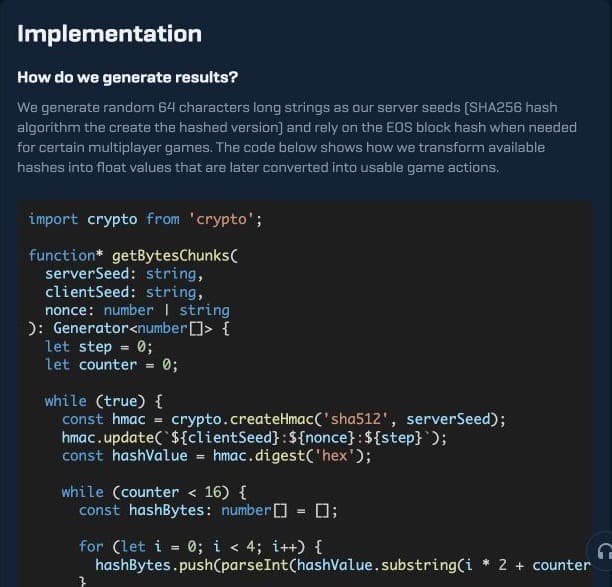
In short:
- Server seed: Rain.gg creates a random 64-character secret and shows its SHA-256 hash before the round.
- EOS block: for battles and Double, Rain.gg names an EOS block that hasn't been made yet. Its id becomes the second number.
- The mix: HMAC-SHA512 of the server seed with "block id : round : seat". The first four bytes of that hash become a number between 0 and 1.
- The result:
- Case battles: that number × 10,000,000 + 1 gives a ticket from 1 to 10,000,000, and every item in a case owns a range of tickets.
- Double: the number × 15 gives the tile from 0 to 14 on the wheel.
- Tie-breaks and jackpot draws use the same mix, with "tie" or "jackpot" added.
A real Rain.gg Double round, step by step
Here's a real round our tracker checked on 11 November 2026, at 13:59 UTC:
| Step | What happened | Check |
|---|---|---|
| 1. Envelope on the table | At 13:59:18 we saved the round's hash, which starts 739b7e8d… | Saved before the result existed |
| 2. Outside number | EOS block #530,182,733 was produced at 13:59:38, 20 seconds later | It didn't exist when the hash was shown ✓ |
| 3. Envelope opened | Rain.gg revealed the server seed d008f73d…051e3f | Its SHA-256 equals the saved hash ✓ |
| 4. The mix | HMAC-SHA512(seed, "block id:1:0") starts with ffdeac30, which reads as 0.9995 | Same as Rain.gg's code |
| 5. The result | 0.9995 × 15 = 14.99, so tile 14 | The wheel showed tile 14 ✓ |
Battles work the same way. In a battle on the same day, round 1, seat 1 got the number 0.0062333. That's ticket 62,333, which falls in the item's range of 40,001 to 70,000. Our tracker matched all 96 items in that battle.
What you can't check publicly (and how to check it yourself)
Solo case openings and the Upgrader use your own seed pair: your client seed, plus a server seed whose hash only you see before the bet. Rain.gg doesn't broadcast those seeds, so nobody else can check them, but you can:
- Set your own client seed before you play. Rain.gg can't predict it.
- Note the server seed hash shown in your account before you open.
- Re-run the opening with its seeds and nonce on Rain.gg's Verify page, once the server seed is revealed.
How we check Rain.gg every hour
Our Provably Fair Tracker watches Rain.gg's public feed, the same way our Live RTP tracker does. For a random sample of rounds (1 in 8 battles and 1 in 10 Double rounds), it:
- Saves the hash the moment the round appears, before any result exists.
- Looks the EOS block up on the public blockchain and checks it came after the hash.
- Hashes the revealed seed and compares it with the saved hash.
- Re-runs Rain.gg's formula and compares every ticket and item with what the site showed.
Which rounds get sampled is decided by a key only we hold, so neither we nor Rain.gg can pick the "nice" ones.
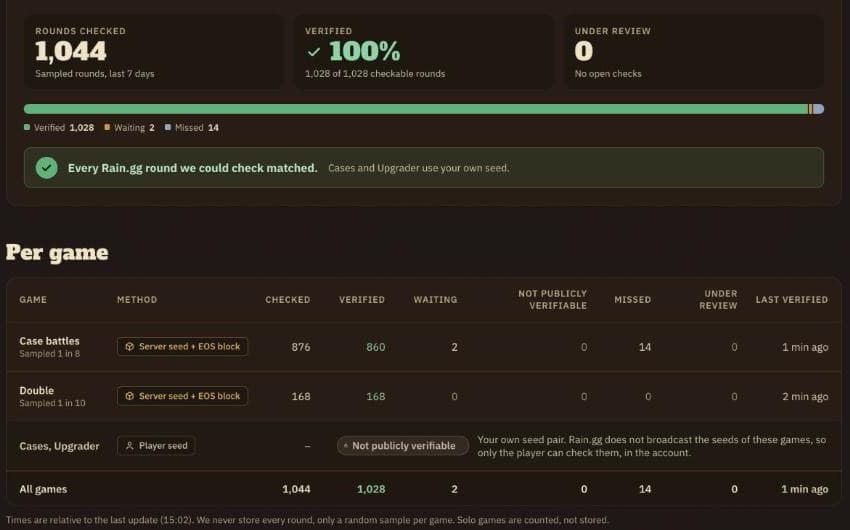
What we found (7 days to 11 November 2026):
| Game | Checked | Verified | Waiting | Missed |
|---|---|---|---|---|
| Case battles | 876 | 860 | 2 | 14 |
| Double | 168 | 168 | 0 | 0 |
| All | 1,044 | 1,028 (100% of checkable) | 2 | 14 |
"Waiting" means the round was still running. "Missed" means our collector joined late or reconnected mid-round, so we skip those rather than guess. None of them means a result was wrong.
Good to know
- Provably fair isn't the same as "you'll win". It proves a result wasn't changed after you bet. The house edge still applies: Rain.gg's cases return about 90%, as our Rain.gg guide and What is RTP? explain.
- Real results line up too. Our Live RTP page shows what Rain.gg players actually got back.
- Want the background? Our CSBattle provably fair guide shows the same idea on another site.
- How the other sites do it: Is Clash.gg provably fair? and Is Packy.gg provably fair?
Frequently asked questions
- Is Rain.gg provably fair?
- Yes, for case battles and Double. Rain.gg shows a hash of its server seed before each round, uses a public EOS block nobody can predict, and reveals the seed afterwards. Our tracker checked 1,028 sampled rounds in 7 days and all matched.
- How does Rain.gg's provably fair system work?
- Rain.gg mixes its secret server seed with an EOS block id using HMAC-SHA512, turns the start of that hash into a number between 0 and 1, and uses it to pick a ticket (1 to 10,000,000) or a Double tile (0 to 14).
- What is the EOS block for?
- It's the outside number. The block is produced on a public blockchain seconds after the round locks, so neither Rain.gg nor the players can know or choose it in advance.
- Can I verify my own Rain.gg case openings?
- Yes. Solo openings use your own seed pair. Set your own client seed, rotate your server seed to reveal the old one, and re-run the opening on Rain.gg's Verify page.
- Why can't you check solo openings for everyone?
- Their seeds belong to each player and aren't broadcast. Only the player sees the hash before the bet, so only the player can check them.
- Does provably fair mean Rain.gg pays back more?
- No. It proves results weren't changed after bets. The return is set by the odds: Rain.gg's cases return about 90%.
- How often do you check Rain.gg?
- All the time. Our collector samples rounds as they happen, and the results on our Provably Fair Tracker update every hour.
18+ only. Gambling can be addictive, play responsibly. Help and advice: BeGambleAware.org. We partnered with Rain.gg until 11 November 2026 and earn nothing from it now. Tracker figures are from 11 November 2026 and update every hour; Rain.gg's own fairness pages are the final word on its method.